How To Improve Healthspan In Your 40s (I’m 46 and Feel Better Than I Did at 40)
How to Feel Younger After 40 (What I Changed at 46)
I’m 46 years old.
And at 42, for the first time in my life, my body started to feel old.
I wasn’t as bouncy.
I wasn’t as fast.
Advertisement
I’d get a stiff neck from sleeping.
Achy lower back from just bending over to pick something up.
Nothing I did before was working the way it used to.
So I changed everything.
And four years later, I move better, recover faster, and feel younger than I did at 42.
On today’s episode of Live Lean TV, I’m sharing exactly how I did it.
Here’s what I figured out.
The real goal isn’t aesthetics.
Why Healthspan Matters More Than Aesthetics After 40
In my 20s and 30s, I trained and ate for one thing.
How I looked, specifically abs and having an overall balanced physique.
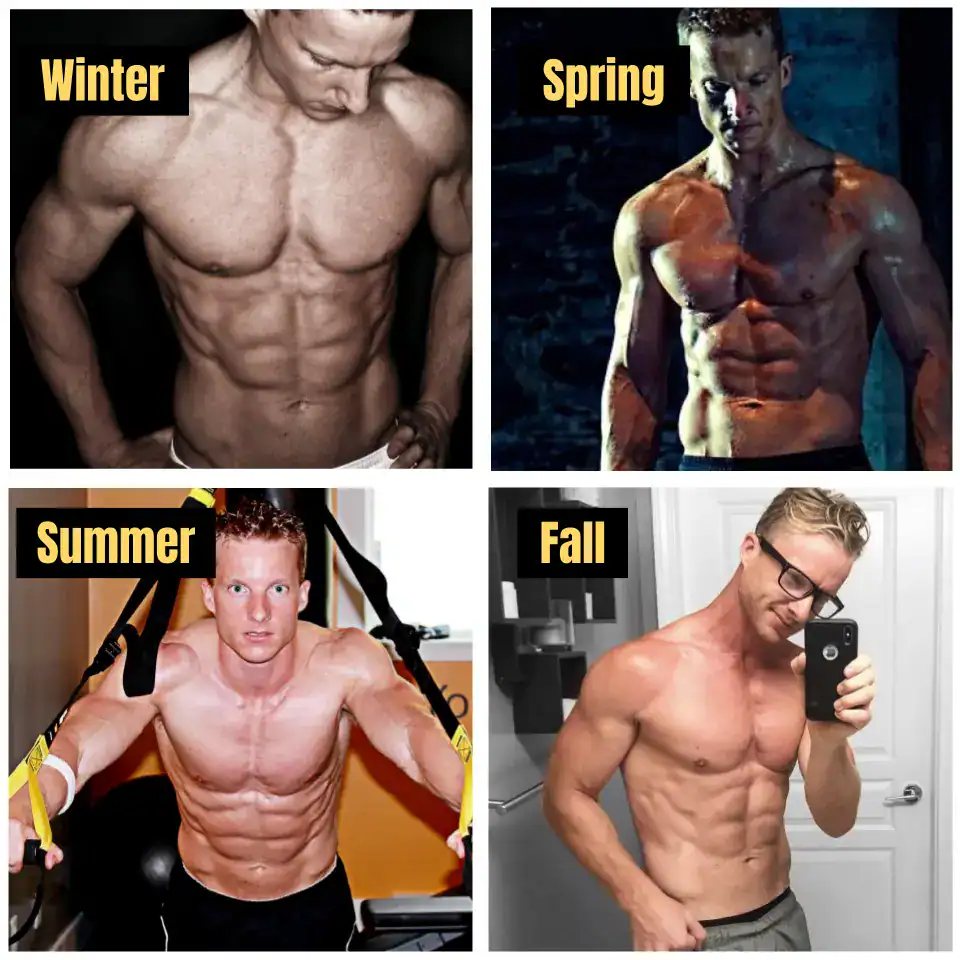
And look, that still matters to me.
But that’s not the game anymore.
The game is now healthspan.
How long I can stay strong, mobile, and capable before my body starts breaking down, while also reducing my risk of chronic disease and death.
To me it’s not just about adding years to my life.
It’s about having a high quality of life in those later years.
I want to be the bouncy grandparent who recovers fast.
The one who gets down on the floor and gets back up, without groaning and not being afraid of tweaking something.
I want wake up with energy, and no stiffness, so I can run around with my grandkids.
I want my kids and my grandkids to look at my health and be inspired by it.
Accomplishing these health span goals at 46 years old comes down to 5 things:
- Exercise
- Nutrition
- Sleep
- Emotional health
- Supplementation
Let’s start with the one that surprisingly moved the needle most for me.
Emotional Health: From ‘By Me’ to ‘Through Me’
The biggest health shift I made at 46 wasn’t physical, it was a spiritual awakening.
I went from “by me” to “through me.”
Here’s what I mean.
You can have your training and nutrition dialed in, but if your nervous system is stuck in overdrive all day, you’re still breaking your body down from the inside.
So I learned to calm it.
Advertisement
This all started with deeper inner work to work through the self-limiting beliefs I was programmed with and carried for years.
Once I started reading, studying, journaling, and 20 minutes of guided meditation a day, I discovered these stories were quietly running the show.
But my inner work led me to a spiritual awakening.
Specifically the move from living with a “by me” level of consciousness, where everything’s on my shoulders, where I have to force it all to happen, to living the “through me” level of consciousness.
In other words, trusting that I’m being divinely guided, and that I don’t have to carry all of it alone.
My mantra is everything has and always will work out for me in the end.
That deep work has literally changed my inner peace and spiritual vibration and frequency.
So, if this sounds familiar, do the inner work.
It’ll take more weight off you than any workout ever could.
If that deep work sounds too intense, here’s an effortless approach.
The Vagus Nerve Reset To Destress My Body
Another thing is I used to have a lot of anxious “what if this happens” thoughts.
Then over a year ago, I started using this vagus nerve stimulation device from Nuropod.
It’s hard to explain it, but my busy racing mind has now quieted down.
Your vagus nerve is basically the off-switch for stress.
It flips you out of that fight-or-flight overdrive and into rest-and-recover mode.
And that’s exactly the state your body needs to be in to feel calm and peaceful.
I’ve been using Nuropod consistently for over a year, 30 minutes in the morning to start the day and 30 minutes before bed to shift into sleep mode.
And it’s not just a feeling of calm, my HRV, which is one of the best markers of how well your nervous system recovers, climbed from 51 all the way up to 88.
So if your nervous system is stuck in overdrive, here’s a discount link to get your own Nuropod.
The discount is automatically applied at checkout.
Huge thanks to Nuropod for sponsoring this post and for genuinely helping with my emotional health.
Now let’s move into exercise.
Here’s how my workouts have changed over the years.
My Weekly Training Split
I’m 46, and I only strength train up to 45 minutes, 4 days a week.
Here’s my exact weekly split to incorporate all 4 training pillars.
#1. Zone 2 cardio
This is your aerobic base, think easy enough to hold a conversation.
For me, that’s walking on an incline treadmill at a 12.0 incline at 3.0 miles an hour.
I do about three hours a week broken down into:
- 2 x 45-minute incline treadmill walks
- 11.5 minute incline walk before and after all 4 strength sessions.
That adds up to 3 hours for the week.
Check out these indepth videos on zone 2 training benefits and zone 2 training for beginners.
#2. VO2 max run
Once a week I push my cardio hard.
To do this, I follow the Norwegian 4×4 protocol:
- 4 minutes at 90-95% of my MHR
- Followed by 3 minutes of an easy walk to let me heart rate drop back to 60-65% of my MHR
- Repeat for 4 intervals
VO2 max is one of the strongest predictors of how long you’ll live.
So you should train it.
#3. Strength Training
- 4 strength training workouts a week
- 35 to 45 minutes each.
- Build muscle, build strength, stay injury-free.
Nothing fancy or super intense, just consistency.
#4. Stability
This is the one everyone skips.
Being bulletproof.
The ability to move, twist, and load your body without hurting your joints and spine.
This is what keeps you off the sidelines for the next 40 years.
That’s the exercise piece.
But training is only one aspect of improving your healthspan.
Because you can’t out-train what you put in your body or how you recover.
If you want more in-depth look at any of these 4 training pillars, let me know in the comments and I’ll create a dedicated post for you.
Next up, let’s talk nutrition.
Nutrition: Test, Don’t Guess
After 20 years of working on my nutrition, here’s the one thing I know for sure.
The perfect diet for everyone doesn’t exist.
And if someone says they have the perfect for everyone, they’re selling you.
Your nutrition is personal to your body, your metabolism, and your bloodwork.
And that becomes way more true in your 40s and beyond.
Test, don’t guess.
Instead of jumping on whatever diet is trending on social media that week, I get my bloodwork done multiple times a year.
I’m currently using Superpower to measure my biomarkers, to see what’s optimized, what’s just normal, and what’s out of range.
Because that’s the difference.
Most people are eating for a body they think they have.
I’m eating for the one my bloodwork actually shows me.
That’s a science-backed diet, built from the inside out, instead of playing the guessing game.
Dial that in, and you’re not chasing trends anymore.
You’re optimizing.
I’m going to be doing more indepth nutrition posts, specifically on calories, protein, carbohydrates, fat, and alcohol soon, so make sure you’re subscribed to my Live Lean TV YouTube channel with notifications on so you don’t miss it.
Now, none of that training or nutrition matters if you’re wrecking your recovery every night.
Sleep Is The Foundation
One night of bad sleep, and your body can’t even process blood sugar properly the next day.
Do that for years, and you’re accelerating everything you’re trying to avoid.
That’s why sleep is the foundation everything else is built on.
In my 20s I treated sleep like it was optional.
In my 40s, I treat sleep like a performance tool, because that’s exactly what it is.
Do that for years, and you’re accelerating everything you’re trying to avoid.
So I dialed in the basics that actually move the needle:
- a cold, pitch-black room
- hard cutoffs on caffeine and blue light from screens before bed
- a consistent wind-down that pulls me out of that wired-but-tired state.
And I track it.
That’s not luck.
That’s the protocol working.
I’ve gone deep on all of this in my other sleep posts here.
Last one, supplementation.
And this ties right back to the bloodwork.
Supplementation: Test, Don’t Guess
If you were like the younger me, you’ll buy whatever supplement is being marketed the hardest that month.
Now that I’m 46, I test, I don’t guess.
My bloodwork tells me exactly what my body needs, and I only supplement what’s actually backed by science.
Here’s the perfect example.
I used to think everyone needed to supplement with vitamin D, and honestly, most people do.
So I was taking 5,000 IU every single day.
But I also prioritize sunshine, especially living in Southern California.
So when I got my bloodwork back, my vitamin D levels were at 110 mg/dl, which is over the top of the optimal range.
I was over-supplementing something my body already had covered.
I never would’ve known without the test.
So I stopped and my levels dropped right back into the optimal range.
Same story flipped the other way with my blood sugar.
Even on a low-carb approach, my HbA1C came back at 5.8% which is out of range.
Now I know, so I can supplement to bring it back down.
That’s the whole point.
Stop guessing.
Test.
Then supplement for the body you actually have.
To me, that’s the whole game.
If this hit home for you, click the social media buttons to share this with your friends and subscribe to my Live Lean TV YouTube channel because I’m breaking down every one of these five pillars in way more depth videos coming up.
Now I want you to watch this video 10 Proven Sleep Tips to Help You Sleep Better Tonight.
Keep Living Lean.
BROWSE MORE EXERCISES TO LIVE LEAN!

Brad Gouthro is the founder of Live Lean TV, a media company focused on helping men and women “Live Lean” 365 days a year. Brad’s programs and content have helped millions of people all over the world learn how to get in shape, and more importantly, sustain it for life.