10 Proven Sleep Tips to Help You Sleep Better Tonight
Listen to the post, Fix Your Sleep: 10 Tips For Deeper, Better Rest, on our Live Lean TV Podcast. Don’t forget to subscribe to the podcast!
How To Sleep Better: 10 Tips For More Energy & Focus
On today’s episode of Live Lean TV, I’m sharing the 10 proven sleep tips to help you sleep better tonight.
However, let me save you some time and just give you the 10 tips right up front:
- Don’t drink alcohol before bed.
- Stop eating three hours before you sleep.
- Turn your screens off two hours before you crash.
- Don’t check your work email or scroll your phone right before bed, nothing stressful, period.
- Take a hot shower right before you get in bed.
- Keep your room cold, like, sweater-weather cold.
- Make it pitch black, no light at all.
- Give yourself 8 to 9 hours to actually sleep.
- Wake up at the same time every single day, weekends too.
- And stop staring at the clock at 3 AM, it’s not helping.
That’s it.
Advertisement
That’s the list.
But if you actually want to know how to do each of these right, and why they work, keep reading.
Table Of Contents – Jump To Links
So let’s start with what’s actually happening in your brain the second you close your eyes.
Deep Sleep: Benefits & How Much Is Required?
Here’s something that’s gonna mess with you a little.
Your best deep sleep already starts fading by the time you hit 30.
When we fall asleep, we move into different sleep stages.
Normally we go through a period of light sleep before dropping into deep sleep, then typically cycling back-and-forth.
Deep sleep is the non-REM stage your brain drops into first, usually dominating the first half of the night.
Deep sleep only makes up about 15-20% of your total sleep, but don’t let that small number fool you.
This is when your brain waves slow way down until you reach a low frequency.
To easily demonstrate how important deep sleep is for brain health, think of your brain like a filing cabinet.
All day it’s throwing memories into a messy pile.
That’s your short-term memory.
Deep sleep is when your brain finally sits down, goes through the pile, tosses what doesn’t matter, and files the important memories into long-term storage.
That’s why the more deep sleep you get, the better you would actually score on a memory test the next day.
But it’s not just memory.
Deep sleep is also when your brain does its cleanup by clearing out cellular junk that’s been linked to memory loss and brain diseases later in life.
So if you’re not getting enough deep sleep, your brain suffers.
Problem is, our ability to hit deep sleep starts dropping off in our late 20s and early 30s, and it gets worse through middle age.
Part of that’s tied to reduction in growth hormone production, which gets released in a big pulse right around the time you drop into deep sleep.
And here’s the kicker.
Research shows your 40s, 50s, and 60s are the decades where deep sleep matters most for keeping your brain healthy and preventing Alzheimer’s disease.
People who slept less during those years may have a higher risk of dementia down the road.
So no, deep sleep isn’t just “feeling rested.”
It’s brain maintenance.
But deep sleep isn’t the only stage pulling its weight every night.
REM Sleep: Benefits & How Much Is Required?
Ever watched someone sleeping and noticed their eyes twitching around under their eyelids?
Advertisement
That’s not random, that’s REM sleep, and it’s wild.
Later in the night we go into REM, short for rapid eye movement.
REM makes up about 20-25% of your night, and most of it is loaded into the second half.
During REM, your eyes are actually moving like you’re watching something, except it’s all happening in your head.
This is where most of your dreaming goes down, and your body basically becomes paralyzed so you don’t act it out.
REM sleep cycles hit about every 90 minutes, and you might even wake up for a few seconds in between without remembering it.
This is likely evolution’s way of protecting us from getting eaten by a saber tooth tiger while sleeping.
When you’re young, REM is doing heavy lifting for brain growth and development, which is why kids spend way more time in it than adults.
As you get older, REM levels off, but it’s still important for your creativity and your ability to solve problems.
Deep sleep and REM get all the credit, but there’s a third stage doing more work than people realize.
Light And Core Sleep: Benefits & How Much Is Required?
Here’s the sleep stage nobody talks about.
And it’s actually where you spend most of your night, about 50-60% of it, actually.
Light sleep, also known as core sleep, is the in-between zone.
It’s not the deep, restorative stuff, and it’s not dream-heavy REM either.
It’s the bridge between the two.
Your heart rate slows down, your body temperature starts dropping, and your muscles relax, all while your body eases you toward the good stuff.
Think of it like the on-ramp to a highway.
You need it to actually get where you’re going.
The problem is, light sleep is also the easiest stage to get yanked out of.
A partner rolling over, a phone buzzing, a dog barking outside.
Any of that can pull you out of light sleep before you ever dive into deep sleep or REM.
So if you keep getting interrupted early in the night, you might be racking up hours in bed without ever getting the sleep that actually counts.
So how do you protect all three stages from getting cut short?
It starts with your bedroom temperature.
What Is The Ideal Sleep Temperature?
You’ve probably got this one backwards.
Being warm doesn’t help you sleep, it actually works against you.
Right as you’re falling asleep, your body temperature naturally drops by about one degree Celsius.
So your bedroom being cool isn’t a bonus, it’s basically a requirement.
Somewhere around 65°F is the sweet spot for most people.
Here’s a trick that actually uses this against the problem.
Take a warm bath or shower before bed.
It’s not just relaxing, it’s strategic.
When you step out of that warm water, your core temperature drops even faster, which basically tells your brain “okay, it’s go time.”
If you’re like me, you run hot at night, especially in the summer.
Even when the fan’s on, the AC is cranked, I still wake up at 3am sweating.
If this sounds familiar, you should check out the Infinity Cool Blanket.
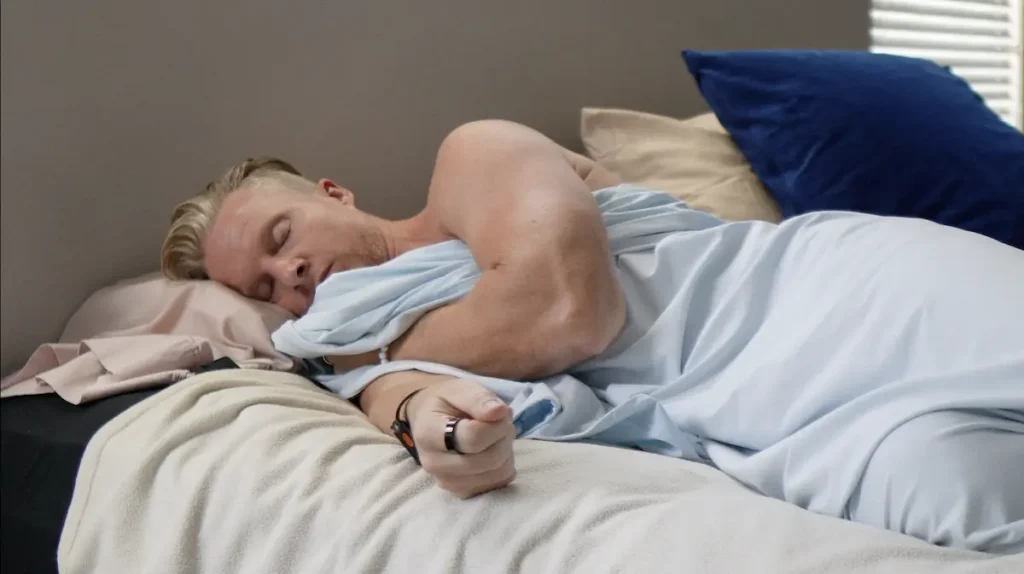
Every time you move, it kicks in an instant cooling effect, dropping the perceived temperature by up to 15°C.
It’s soft, stretchy, fully machine washable, dries fast, and resists pilling, so it stays fresh wash after wash.
And it’s not just for the bed.
You can bring it to the couch, take it outside, or use it wherever you need to cool down.
If you’re done with sweaty, sleepless summer nights, the Infinity Cool Blanket is live on Kickstarter right now, if you want to check it out.
This One Sleep Environment Mistake Ruins Your Night
Your bedroom might be quietly sabotaging your sleep and you don’t even realize it.
You must create an environment for yourself that is conducive to sleeping well.
Rule number one is darkness, and I mean real darkness.
Use blackout curtains or a sleep mask and get rid of every little light source, even the tiny LEDs on your TV or clock.
They seem harmless, but they’re bright enough to mess with your sleep.
Same goes for digital clocks.
Not just because the numbers glow, but because if you wake up, glance over, and see it’s 3:31 AM, now you’re doing math about your 7am meeting and you’re never falling back asleep.
Light also interferes with your natural circadian rhythm as your brain uses darkness to release a hormone called melatonin that tells your body “it’s time to sleep.”
The second your brain picks up bright or blue light, it thinks it’s still daytime and blocks that hormone from helping you fall asleep.
So a couple hours before bed, start dimming down the lights.
Turn off lights you don’t need, and if you can, swap out harsh white bulbs for warmer ones.
And your phone, laptop, and video games?
Worse offenders.
Not only do they blast blue light at your face, they keep your brain switched on and alert.
Gaming one hour before bed activates the brain, which is way worse than passively watching TV or reading a book.
Bottom line.
Power down the screens at least 2 hours before bed, and don’t bring them into bed with you.
Alright, that’s the science.
Now let’s turn it into action.
10 Sleep Habits For Better Sleep
Alright, here’s the cheat sheet.
10 things you can start doing tonight to improve your sleep.
You don’t need to do all 10 to see a difference, just stack as many as you can:
- Skip the nightcap, or limit yourself to one drink of alcohol before 6 PM. Alcohol wrecks your sleep quality more than almost anything else you control. Feeling drowsy is not the same thing as sleeping well.
- Stop eating at least three hours before bed. Go to sleep a little hungry, not stuffed.
- Cut screens two hours before bed. If you can’t fully quit them, at least dim the blue light or wear red lens glasses to block the blue light.
- Nothing stressful an hour before bed. No work email, no doom-scrolling. I personally use these tuning forks from Pure Frequencies before bed for about four minutes. They use vibration to calm your nervous system down and drop cortisol. I can actually watch my stress readings on my Oura ring drop within 15 minutes of using them.
- Get in a hot bath or shower before bed.
- Keep your room in the mid-60s, or grab a cooling mattress and cooling blanket like the Infinity Cool Blanket IV if you run hot.
- Make your room pitch black with black out curtains or sleep mask. If you can’t see your hand in front of your face, you’re doing it right.
- Give yourself enough time to actually sleep. That means getting in bed at least eight hours before you need to be up, nine if you can swing it.
- Same wake-up time every day, weekends included. Your body loves consistency way more than it loves sleeping in.
- Stop obsessing over your sleep. Turn your clock away from you so you’re not staring at it at 3 AM, and if checking your sleep score every morning stresses you out more than it helps, ditch the tracker. Sleep anxiety is real, and it makes everything worse.
These tips help create better conditions for sleeping, letting your brain and body do the rest.
It’s best not to obsess over sleep so you don’t need to do them all but the more you do the better your odds of getting a good night sleep.
But how do you actually know if any of this is working?
That’s where these come in.
Sleep Questionnaire
If you want to know exactly how good or bad your sleep actually is, there’s real tests for that, not just guessing.
The gold standard is the Pittsburgh Sleep Quality Index (PSQI).
It’s a quick self-assessment that scores how well you’ve actually been sleeping over the past month.
Then there’s the Epworth Sleepiness Scale (ESS), which is a short quiz that measures how likely you are to doze off during the day.
It can flag whether it’s time to actually see a sleep specialist.
And last is the Insomnia Severity Index (ISI) , which includes 7 quick questions that measure how bad your insomnia really is, including trouble falling asleep, staying asleep, waking up too early, and how much it’s messing with your day-to-day life.
But good sleep isn’t only about nighttime.
It starts with your whole day.
Exercise, getting outside, and not stuffing your face right before bed, easing off the alcohol, and actually managing your stress instead of carrying it into bed with you.
Alright, those were my best 10 Tips To Improve Your Sleep.
If this helped, smash that like button, drop a comment telling me which tip you’re trying tonight, and subscribe to my YouTube channel so you don’t miss what’s next.
And speaking of next, I made a video on the 5 sleep mistakes that are quietly wrecking your nights, so go watch that one right now.
Thanks for watching and keep Living Lean.
BROWSE MORE EXERCISES TO LIVE LEAN!

Brad Gouthro is the founder of Live Lean TV, a media company focused on helping men and women “Live Lean” 365 days a year. Brad’s programs and content have helped millions of people all over the world learn how to get in shape, and more importantly, sustain it for life.