VO2 Max Training: How To Increase Your VO2 Max After 40 (Charts + Protocols)
Listen to the post, My VO2 Max Dropped 25In 5 Years. Here’s How I Got It Back, on our Live Lean TV Podcast. Don’t forget to subscribe to the podcast!
The Complete Training Guide To Blow Up Your V02 Max
In five years, my VO2 max dropped 25%.
It went from 46.5 as a 37 year old, down to 34.7 as a 42 year old.
And if you’re over 30 and you’ve never trained this, yours is dropping right now too.
Advertisement
However, the good news is, by following the steps in this post, I got mine back up to 41.4, at 45 years old.
Here’s why that matters.
VO2 max is your body’s engine size.
It’s how much oxygen you can actually use when you’re working hard.
And research shows V02 max might be the single best predictor of how long you’ll live, and more importantly, how well you’ll live.
So on today’s episode of Live Lean TV, I’m breaking down exactly what VO2 max is, the workouts proven to improve it on a treadmill, a bike, and even a kettlebell, how to track it with your Apple Watch or Garmin, and what your number should actually be for your age
Let’s get into it.
Table Of Contents – Jump To Links
- V02 Max Explained: What V02 Max Means
- V02 Max Training: How To Get Started
- VO2 Max Workout VS. HIIT Workouts: What's The Difference
- Norwegian 4×4 Interval Training Workout Structure
- V02 Max Training Cycling / Stationary Bike Workout Structure
- Top Kettlebell V02 Max Protocols: Workout Structure
- How To Test V02 Max At Home: Apple Watch & Garmin
- My VO2 Max Dropped 25% In 5 Years
- V02 Max Test Protocol For Your Real V02 Max
- V02 Max Chart By Age And Gender: What's Good And Bad?
- VO2 Max Ranges To Aim For: General Population Targets
- Your Game Plan To Improve Your V02 Max
V02 Max Explained: What V02 Max Means
If Zone 2 training is cruise control, VO2 max training is flooring it up the hill.
Think of Zone 2 training as a steady pace you could maintain while still carrying a conversation.
Now, VO2 max training is almost the opposite.
Think higher intensity interval training.
Not an all-out sprint, but a few minutes of hard effort where your breathing starts sounding like Darth Vader.
Here’s what’s happening.
Your lungs breathe in oxygen, your heart pumps it to your muscles, and your muscles burn it for energy.
VO2 max is the most oxygen your body can use in one minute.
You usually hit your V02 max right before you reach failure and you can’t go any further, without stopping.
You know, that moment your body says, “Nope. We’re done.”
At this point, you’re using a combo of both your aerobic and anaerobic pathways for energy, but your oxygen consumption is maxed out.
That’s your engine size.
And you don’t need to be an athlete for this number to matter.
Everyone should know their V02 max.
So here’s how you actually train it.
V02 Max Training: How To Get Started
My VO2 max is higher at 45 than it was at 42.
In other words, I’m functionally younger now than I was three years ago.
According to my Apple Watch, my VO2 max crashed to 34.7 at age 42.
Three years later, I’m back up to 41.4.
Sure, I’m chronologically older on paper, but I’m biologically fitter where it counts.
That’s the power of VO2 max training.
Advertisement
A bigger engine helps you keep doing the things you love as you age, playing sports, keeping up with your kids and grandkids, and even carrying all the groceries in one trip.
And the best part?
You can improve your V02 max at any age.
Now, if you’re new to exercise, don’t jump straight into V02 max training.
You need to build your aerobic base first with about 5 to 6 months of Zone 2.
Then add one or two VO2 max workouts per week on top of it.
But VO2 max training isn’t your typical HIIT class.
Here’s what makes it different.
VO2 Max Workout VS. HIIT Workouts: What’s The Difference
Most people think VO2 max training is just HIIT.
It’s not.
And getting this wrong means you miss the benefits.
HIIT intervals are short, usually measured in seconds.
VO2 max intervals are longer, typically 3 to 8 minutes, and a notch less intense.
Hard enough that heart rate hits 90-95% of max heart rate so you’re counting down every second, but still controlled enough to hold the pace.
And here’s the part most people skip: recovery.
Between rounds, it’s very important to rest long enough to get close to fully recovered, where your heart rate drops back down to 60-70% of max heart rate.
A good rule of thumb is to rest about as long as you worked.
If you start the next round still gassed, you can’t hit peak effort, which means you miss the results you came for.
And don’t skip your warm up and cool down.
You can do V02 max workouts on a treadmill, running on an outdoor track, field, or sidewalk, cycling, and indoor stationary bike, a rower, or even with a kettlebell.
So let’s break down exactly how to do it, starting with one of my favorite, the Norwegian 4×4 Interval Training Workout.
Norwegian 4×4 Interval Training Workout Structure
If you only do one VO2 max workout, make it this one.
It’s called the Norwegian 4×4 interval training workout.
It was developed by researchers in Norway, and it’s one of the most studied VO2 max workouts on the planet.
In one study, it boosted VO2 max by about 7% in just eight weeks, while steady cardio barely moved the needle.
It’s been used with everyone from elite athletes to heart patients.
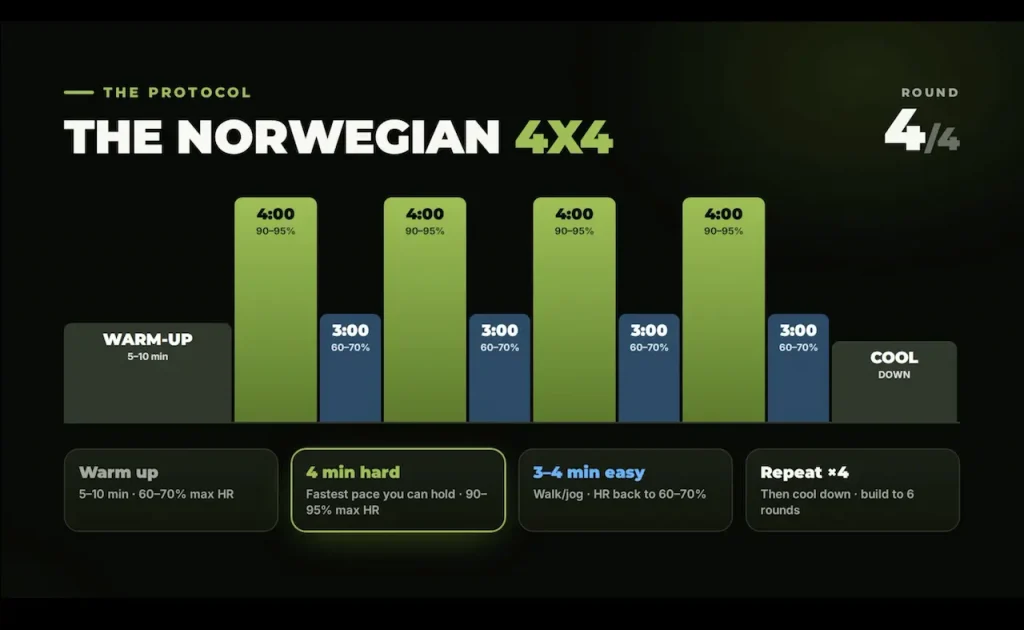
Here’s how the Norwegian 4×4 Interval Training Workout works:
- Warm up for 5-10 minutes to bring your heart rate up to 60-70% of your max heart rate.
- Then go hard for 4 minutes, at the fastest pace you can hold for the full 4 minutes. Since the interval is 4 minutes, it’s not a sprint, but it’s tough to sustain. Your heart rate should climb to about 90 to 95% of your max heart rate.
- Then walk easy for 3 to 4 minutes to recover and allow your heart rate to drop back down to 60-70% of your max heart rate.
- Repeat that 4 times, and cool down.
As you get fitter, build up to 6 rounds.
You can do it on a track, a field, a treadmill, stationary bike, or cycle.
Not a runner?
No problem.
V02 Max Training Cycling / Stationary Bike Workout Structure
Want the V02 Max benefits of the Norwegian 4×4 interval training workout without pounding your knees?
Get on a stationary bike or cycle:
- Start with about 5-10 minutes of easy Zone 2 cycling.
- Then push hard for 4 minutes, at a sustained effort of 90 to 95% of your max heart rate. If you know your functional threshold power (FTP), which is the most power you can hold for about an hour, go about 110 to 120% of your FTP. Or go by feel at an effort where you can only get out a word or two out, max.
- Keep it steady for the full 4 minutes, rather than blasting the first minute and dying on the last one.
- After the 4 minute interval, transition to 3 minutes of easy spinning at 60–70% of max heart rate.
- Repeat 4 times and cool down for 5-10 minutes.
Now, if running and cycling aren’t your thing, there’s one more option, and it went viral on TikTok.
Top Kettlebell V02 Max Protocols: Workout Structure
You’ve probably seen the kettlebell swing ladder all over TikTok.
But does it actually boost your VO2 max?
Here’s how to do the kettlebell swing ladder:
- Select a kettlebell weight you can comfortably complete for 20 reps.
- Do 1 kettlebell swing, set the bell down, and take 1 slow breath through your nose.
- Then 2 swings, 2 breaths.
- Keep climbing all the way up to 20 swings and 20 breaths, then work your way back down.
Sure this seems like a great conditioning workout, but I couldn’t find a single study showing swing ladders improve VO2 max.
That’s not to say it doesn’t work, there’s just no research that backs it up like the Norwegian 4×4 interval training protocol does.
But if you love kettlebell workouts this is one with some V02 max research behind it using the kettlebell snatch exercise.
In one small study, athletes used a kettlebell they could snatch with good form for the full 20 minutes.
They did 15 seconds of kettlebell snatches with one hand, then rested 15 seconds, then switched hands and completed another 15 seconds.
They repeated that for 20 minutes, and completed it three times a week.
After four weeks their VO2 max jumped about 6%.
And if you want to combine both, do the Norwegian 4×4 with kettlebells.
Four minutes of work, three minutes of recovery, four rounds.
Just know this: with explosive kettlebell moves, your heart rate can climb higher than your actual oxygen use.
So your watch might make it look harder on your engine than it really is.
So how do you actually track your V02 max?
How To Test V02 Max At Home: Apple Watch & Garmin
Your Apple watch and Garmin smartwatch has been quietly calculating your VO2 max.
Here’s how it works and how to get an accurate reading.
But first, the V02 max gold standard is a lab test.
You put a mask on your face, step on a treadmill, and have someone yelling at you to “keep going!”.
But your Apple watch or Garmin can give you a solid estimate.
Your Apple Watch compares how hard your heart is working to how fast you’re moving, then factors in your age, sex, height, and weight.
Garmin works in a similar way.
Just remember, these are estimates so don’t obsess over one reading.
Watch the trend.
And my trend told me a story I didn’t want to hear.
My VO2 Max Dropped 25% In 5 Years
And my Apple Watch saw it happen month by month.
Back in March 2018, at age 37, my VO2 max peaked at 46.5.
At the time, I was doing interval training consistently.
Then I stopped interval training and zone 2 training to focus on primarily on resistance training.
And from early 2022 to early 2023, my number dropped almost every single month, all the way down to 34.7 at age 42.
That’s not normal aging.
That’s a shrinking engine.
So I brought zone 2 and Norwegian 4×4 interval training back, and today, at 46 years old, I’m back up to 41.4.
When I did intervals, my VO2 max went up, but when I stopped, it went down.
It’s that simple.
There’s only one way to get your true V02 max.
V02 Max Test Protocol For Your Real V02 Max

Want to know your real VO2 max, not a watch estimate?
You’ll need a mask and a lot of sweat.
A lab VO2 max test measures exactly how much oxygen you breathe in and out while the workout gets harder and harder.
During the V02 max treadmill test, the speed or incline goes up every minute or two.
During the V02 max cycling test, the resistance climbs.
You keep going until you physically can’t.
Most tests last about 8 to 12 minutes, and trust me, that last minute feels like an hour.
Treadmill scores usually come out a bit higher, because running uses more muscle.
But if you’re a cyclist, or your knees hate running, the V02 max cycling test is the better fit.
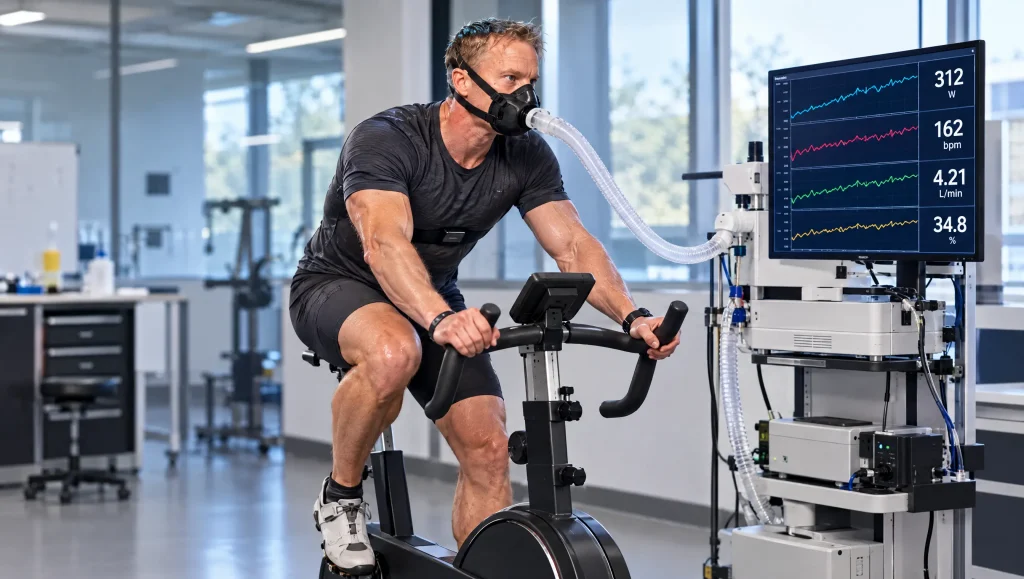
Whichever you choose, use the same test every time so you’re comparing apples to apples.
So you’ve got your number, now the big question: is it any good?
V02 Max Chart By Age And Gender: What’s Good And Bad?
What’s a good VO2 max for your age and gender?
And what happens when yours keeps dropping?
| Age | Poor<20th % | Fair20–40th % | Average40–60th % | Good60–80th % | Excellent80–90th % | Superior90th %+ |
|---|---|---|---|---|---|---|
| 20–29 | <35.2 | 35.2–43.5 | 43.6–48.9 | 49.0–54.4 | 54.5–58.5 | 58.6+ |
| 30–39 | <29.8 | 29.8–36.9 | 37.0–43.3 | 43.4–49.9 | 50.0–55.4 | 55.5+ |
| 40–49 | <26.7 | 26.7–32.3 | 32.4–37.8 | 37.9–45.1 | 45.2–50.7 | 50.8+ |
| 50–59 | <22.2 | 22.2–26.8 | 26.9–31.7 | 31.8–38.2 | 38.3–43.3 | 43.4+ |
| 60–69 | <18.5 | 18.5–22.7 | 22.8–26.4 | 26.5–31.9 | 32.0–37.0 | 37.1+ |
| 70–79 | <15.9 | 15.9–19.0 | 19.1–22.1 | 22.2–25.8 | 25.9–29.3 | 29.4+ |
| 80–89 | <14.8 | 14.8–16.5 | 16.6–18.3 | 18.4–21.3 | 21.4–22.7 | 22.8+ |
Values are lab-measured treadmill VO2 max in mL/kg/min. Cycling test results typically run lower. Source: Kaminsky LA, et al. Updated Reference Standards for Cardiorespiratory Fitness Measured with Cardiopulmonary Exercise Testing. Mayo Clinic Proceedings, 2022. View study
| Age | Poor<20th % | Fair20–40th % | Average40–60th % | Good60–80th % | Excellent80–90th % | Superior90th %+ |
|---|---|---|---|---|---|---|
| 20–29 | <27.2 | 27.2–33.9 | 34.0–38.9 | 39.0–44.7 | 44.8–48.9 | 49.0+ |
| 30–39 | <21.9 | 21.9–26.3 | 26.4–30.9 | 31.0–36.9 | 37.0–42.0 | 42.1+ |
| 40–49 | <19.7 | 19.7–23.8 | 23.9–27.6 | 27.7–32.9 | 33.0–37.7 | 37.8+ |
| 50–59 | <18.5 | 18.5–21.4 | 21.5–24.5 | 24.6–28.3 | 28.4–32.3 | 32.4+ |
| 60–69 | <15.4 | 15.4–18.2 | 18.3–20.8 | 20.9–24.2 | 24.3–27.2 | 27.3+ |
| 70–79 | <14.0 | 14.0–16.1 | 16.2–18.2 | 18.3–20.7 | 20.8–22.7 | 22.8+ |
| 80–89 | <12.6 | 12.6–14.6 | 14.7–15.9 | 16.0–18.3 | 18.4–20.7 | 20.8+ |
Values are lab-measured treadmill VO2 max in mL/kg/min. Cycling test results typically run lower. Source: Kaminsky LA, et al. Updated Reference Standards for Cardiorespiratory Fitness Measured with Cardiopulmonary Exercise Testing. Mayo Clinic Proceedings, 2022. View study
VO2 max naturally drops as you age.
On average, V02 max falls about 10% per decade, and even faster later in life.
Men also tend to score higher than women at every age.
Here’s why that matters.
The lower your VO2 max, the less you can do.
Take a guy with a VO2 max in the mid-30s.
A 10-minute mile, which is basically a 6 mph jog, is his all-out max.
He can’t hold it.
The lower your VO2 max drops, the harder everyday life gets such as climbing stairs and carrying groceries.
This is your engine failing.
So what number should you actually be chasing?
VO2 Max Ranges To Aim For: General Population Targets
Being average for your age isn’t good enough.
Here’s the VO2 max you should actually be chasing.
Think about it.
If your VO2 max is average now, and it drops about 10% every decade and up to 15% per decade after the age of 50.
So where does that leave you at 70? Or 80?
That’s why the goal isn’t average, it should be optimal.
Being in the superior range for your age and gender.
If you are already there, aim higher by being superior for someone two decades younger.
Think of it as building a buffer.
If you want to stay active at 80, start training for it at 40.
The bigger your engine now, the longer it keeps running later.
And the payoff is huge as it’s linked to up to 50% drop in risk of dying early.
It’s hard work.
But it’s the price of staying active and independent for life.
Your Game Plan To Improve Your V02 Max
- Build your aerobic base with Zone 2.
- Add one or two VO2 max workouts per week.
- Keep lifting, 4 times per week.
Zone 2 builds your aerobic base, VO2 max builds your engine, and strength training builds your armor.
And look, I let my engine shrink for a few years.
It happens.
Life gets busy.
But the number went back up, at 45, which means yours can too.
Remember. the workout you do today is an investment in the body you’ll be living in at 70.
So do this for me.
Check your VO2 max this week.
Whether it’s your Apple Watch, your Garmin, or a lab test, find your number, and use the V02 Max range chart to see where you stand.
Then drop it in the comments and tell me what you’re starting with.
And if you want to build the engine and the muscle, you can try my Live Lean workout app free for 7 days.
Keep Living Lean.
BROWSE MORE EXERCISES TO LIVE LEAN!

Brad Gouthro is the founder of Live Lean TV, a media company focused on helping men and women “Live Lean” 365 days a year. Brad’s programs and content have helped millions of people all over the world learn how to get in shape, and more importantly, sustain it for life.