How To Lower Your Resting Heart Rate Especially Before Bed
Listen to the post, The Number That Predicts How Long You’ll Live (And How To Lower It Tonight), on our Live Lean TV Podcast. Don’t forget to subscribe to the podcast!
10 Ways To Lower Your Resting Heart Rate Before Bed
My resting heart rate just hit the 40s.
So on today’s episode of Live Lean TV, I’m showing you the steps I’ve taken to lower my resting heart rate, especially before bed.
Here’s why this matters.
Advertisement
Having a low resting heart rate, especially right before bed, might be one of the most important predictors of your overall health and how long you live.
Bryan Johnson, who’s spent millions optimizing his body, tracks his resting heart rate before bed obsessively, because the science shows having lower number means you fall asleep faster and sleep deeper.
Plus, your resting heart rate might literally predict how long you’re going to live.
Large studies have found the same pattern again and again: people with lower resting heart rates tend to live longer, and people with higher ones face greater risk.
The good news is you can lower yours, starting tonight.
Table Of Contents – Jump To Links
- Resting Heart Rate Explained (It's Simpler Than You Think)
- Resting Heart Rate Before Bed: Why It Matters Most
- How To Lower Your Resting Heart Rate Before Bed
- How To Switch Your Body Out Of Stress Mode Before Bed
- Resting Heart Rate By Age: Is Yours Actually Normal?
- Resting Heart Rate Over 80 or 100? Your Body's Warning You
- How To Measure Resting Heart Rate (Most Get It Wrong)
But before you can lower it, you need to understand what exactly IS your resting heart rate.
Resting Heart Rate Explained (It’s Simpler Than You Think)
It’s dead simple.
Your resting heart rate is how many times your heart beats per minute when you’re doing nothing.
Think of your heart like a car engine.
A low resting heart rate means your engine is powerful and efficient.
It pumps a ton of blood with every beat, so it barely has to work.
A high resting heart rate means your engine is revving hard just to idle.
For most adults, that number lands between 60 and 100 beats a minute.
But having a lower resting heart rate in the 40s and 50s is usually stronger and what you should be striving for.
A heart that isn’t stressed should have a resting heart rate that sounds even and calm.
And here’s why knowing your resting heart rate before bed is so important.
Resting Heart Rate Before Bed: Why It Matters Most
Of every number your fitness tracker measures, your resting heart rate right before bed might matter most.
Here’s why.
When your heart rate is still high as you’re trying to fall asleep, it’s a sign you’re stressed, alert, and wired, meaning your body is stuck in “go” mode.
You fall asleep slower, and the sleep you do get is shallow and broken.
But when you bring that number down before bed, you flip into “rest and recover” mode.
You fall asleep faster, you sink into deep sleep, and you wake up actually restored.
That’s the whole game.
A lower heart rate before bed is better sleep, better recovery, and a longer life.
So how do you actually drop it tonight?
Let’s get to work.
This is where everything we just covered turns into action.
How To Lower Your Resting Heart Rate Before Bed
Here are 10 ways to drop your resting heart rate before bed:
- Skip the heavy late meal and finish eating at least 3 hours before bed.
- Cut caffeine 8–12 hours before bed.
- Skip the nightcap. No alcohol, or if you need it, limit it to one drink before 6pm.
- Workout earlier. No hard workouts within 4 hours of bed.
- Build your aerobic base with 3 hours of Zone 2 cardio training per week.
- Kill blue light from screens at least 1 hour before bed.
- Implement a wind-down routine before bed comprised of reading, walking, or journaling.
- Reduce night time anxious thoughts and calm your mind by stimulating your vagus nerve with Nuropod, or meditating, or breath work.
- Make your bedroom cold, dark, and quiet.
- Same bedtime, every single night.
Pick two or three of those tips and implement them this week.
Advertisement
But if there’s one to focus on, it’s this.
How To Switch Your Body Out Of Stress Mode Before Bed
If you only fix one thing before bed to lower your heart rate, make it this: switch your body out of stress mode.
Your vagus nerve is the master brake pedal for your entire nervous system.
Activate it, and your heart rate drops within minutes.
To do this, take slow, extended exhales.
Breathe out longer than you breathe in, and you’re manually tapping that brake.
But the version I use every night before bed does this for me, effortlessly.
It’s called Nuropod.
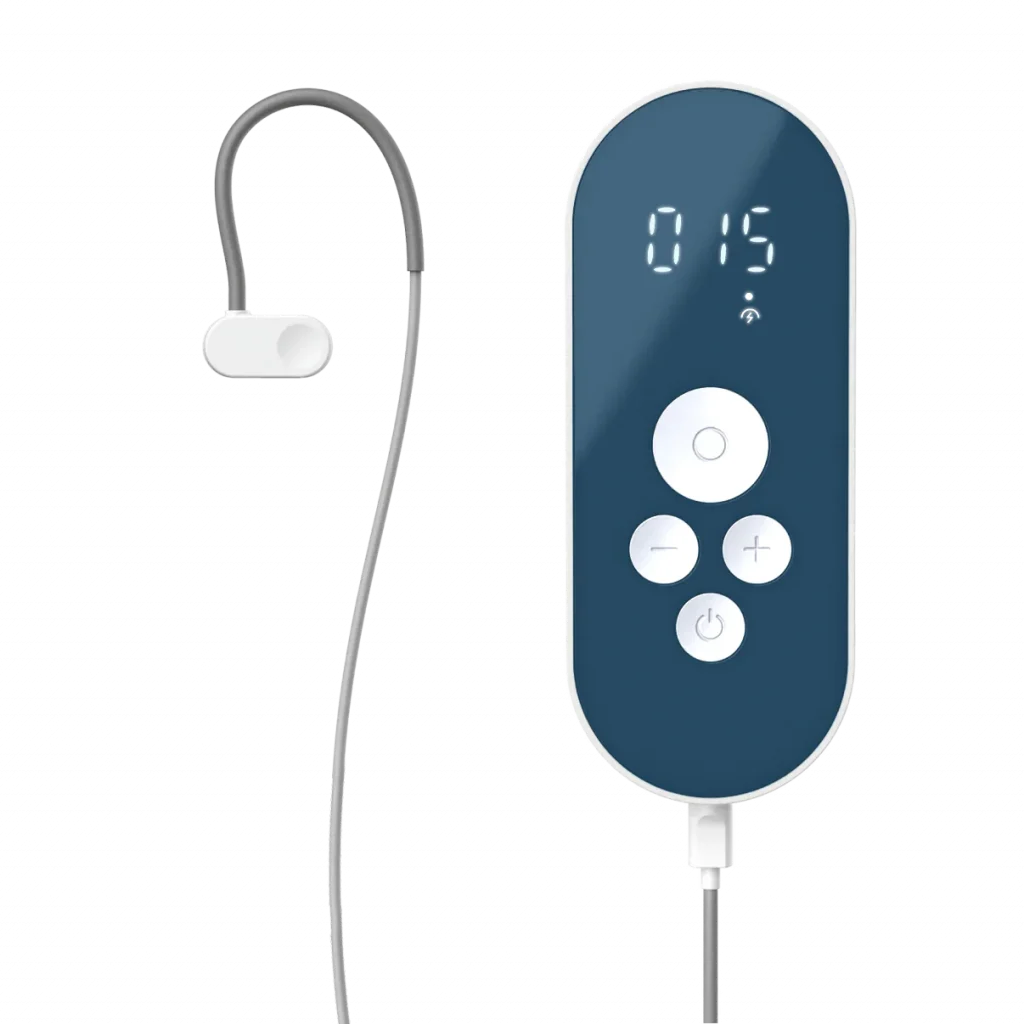
It gently stimulates your vagus nerve, so instead of lying there trying to force yourself calm, your body downshifts into rest-and-
recover mode automatically.
I simply clip it on the tragus part of my ear during my wind-down, and I can watch my heart rate drop in real time before I even close my eyes.
I’ve been using it consistently for exactly one year.
My resting heart rate has dropped into the 40s, my Apple Watch shows my HRV monthly average was as high as 88 ms last month, and my anxious thoughts before bed have decreased, so I can fall asleep faster and recover better every single night.
Check out my full Nuropod Review here where I documented all of my results after 10 months of using it.
If lowering your heart rate before bed is the goal, here’s a discount link to Nuropod.
The discount will be automatically applied at checkout.
Now let’s find out if your resting heart rate is where it should be, based on your age and gender.
Resting Heart Rate By Age: Is Yours Actually Normal?
Here’s what almost nobody tells you about your resting heart rate.
What counts as “normal” completely changes with your age and gender.
For adults, whether you’re a man or a woman, an “average” resting heart rate usually sits between 60 and 100 beats per minute (bpm).
But “average” and “optimal” are two different things.
A resting heart rate below 60 bpm is usually a sign of a well-trained engine.
Many fit individuals and athletes typically have a resting heart rate between 40 and 60 bpm, and some endurance athletes could even be in the 30s.
I’m 46 and my resting heart rate has just started dropping into the 40s.
Always remember, when it comes to your health the goal isn’t just “normal.”
It’s optimal.
And if you’re a women, your resting heart rate tends to run a few beats per minute higher than men’s on average, since your heart is typically smaller and beat slightly faster to move the same blood.
| Age | Athletic / Highly Fit Reference range† | Men Typical range* | Women Typical range* |
|---|---|---|---|
| 20–39 years | 40–60 bpm | 61–76 bpm | 66–82 bpm |
| 40–59 years | 40–60 bpm | 61–77 bpm | 64–79 bpm |
| 60–79 years | 40–60 bpm | 60–75 bpm | 64–78 bpm |
| 80+ years | 40–60 bpm | 68–86 bpm | 64–85 bpm |
*Typical range: approximately the middle 50% (25th–75th percentile) of resting pulse measurements from the CDC/NHANES reference population. These are population reference values, not diagnostic thresholds.
†Athletic / highly fit reference: 40–60 bpm is a commonly recognized resting-heart-rate range for trained athletes and some highly fit healthy adults. It is a general fitness reference rather than an age-specific medical target. Some very fit athletes may have resting heart rates near 40 bpm or slightly below.
According to the Cleveland Clinic, kids naturally run higher resting heart rates as infants and toddlers, and steadily drop as they grow into adolescence.
| Age Group | Normal Heart Rate (bpm) |
|---|---|
| Newborn (birth to 4 weeks) | 100–205 |
| Infant (4 weeks to 1 year) | 100–180 |
| Toddler (1 to 3 years) | 98–140 |
| Preschool (3 to 5 years) | 80–120 |
| School-age (5 to 12 years) | 75–118 |
| Adolescent (13 to 17 years) | 60–100 |
But regardless of your age or gender, if your heart rate is very low AND you feel dizzy, lightheaded, or wiped out, that’s worth a conversation with your doctor.
And if your resting heart rate is high your body trying to tell you something.
Resting Heart Rate Over 80 or 100? Your Body’s Warning You
If your resting heart rate is over 100 bpm while you’re just sitting there, your body is waving a red flag.
Doctors call it tachycardia, and it can be a sign of stress, dehydration, poor sleep, too much caffeine, or something that deserves a real check-up.
Now, a resting heart rate of 80 bpm isn’t an emergency.
Unfortunately, based on today’s sedentary lifestyle, it’s technically “normal.”
But it’s higher than ideal and it’s telling you there’s room to bring that number down.
The point is simple: the higher your resting number, the harder your heart is working just to keep you alive.
And since your heart has a finite number of beats in it, a calmer, more efficient heart is quite literally conserving them.
So let’s make sure you’re even measuring it right.
How To Measure Resting Heart Rate (Most Get It Wrong)
Most people measure their resting heart rate completely wrong, and it makes their number look worse than it is.
Here’s the fix.
The real test is right when you wake up, before you sit up, before coffee, before you even look at your phone.
That’s your true resting heart rate.
I use an Apple Watch and Oura Ring, but any fitness tracker measures this automatically, all day and all night, which means you can finally see the number that matters most.
However, if you don’t use a fitness tracker, go old-school by finding your pulse on your wrist or neck, count the beats for 15 seconds, then multiply it by 4.
If this helped, smash that like button, drop a comment telling me which tip you’re trying tonight, and subscribe to my YouTube channel so you don’t miss what’s next.
And don’t stop here, go check out this video on 10 Proven Sleep Tips to Help You Sleep Better Tonight.
Keep Living Lean.
BROWSE MORE EXERCISES TO LIVE LEAN!

Brad Gouthro is the founder of Live Lean TV, a media company focused on helping men and women “Live Lean” 365 days a year. Brad’s programs and content have helped millions of people all over the world learn how to get in shape, and more importantly, sustain it for life.